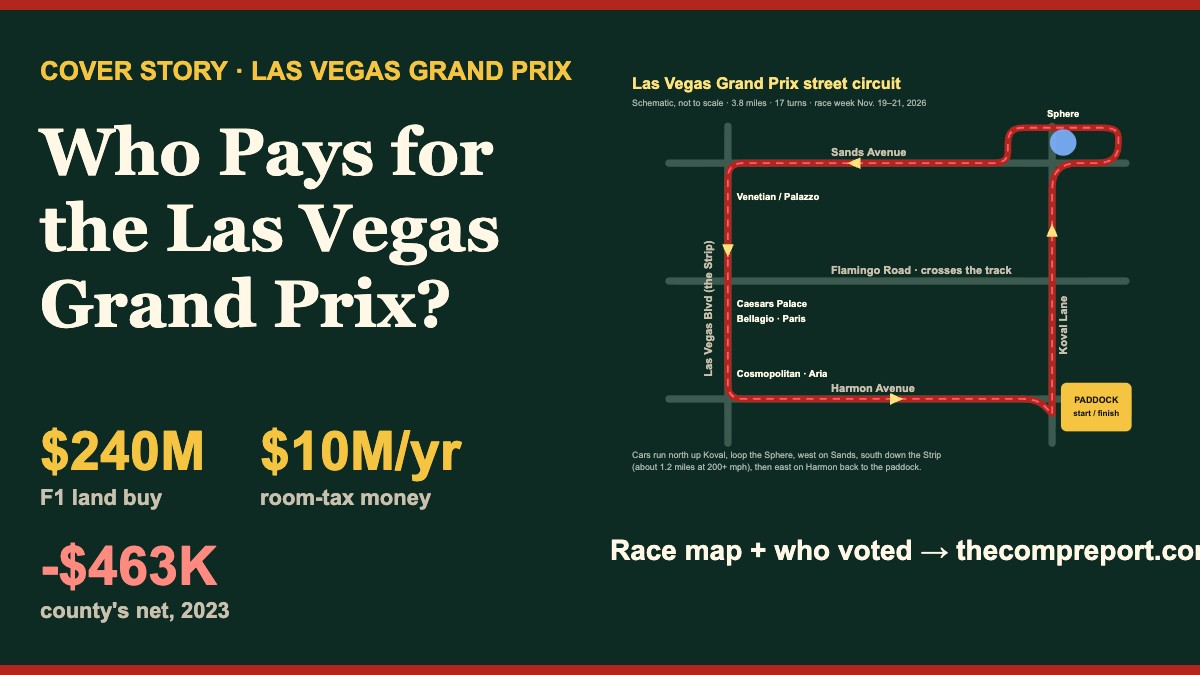
Every fall, the Las Vegas Strip turns into a Formula 1 racetrack for one weekend. Getting it ready takes months of lane closures around Koval, Sands, Harmon and Flamingo. Here’s who owns the race, who pays for it, what it brings in, and whether that trade-off is worth it.
Key Takeaways
- Formula 1’s owner, Liberty Media, runs the Las Vegas Grand Prix itself. Most F1 races use a local promoter, but in Vegas F1 bought 39 acres off the Strip for about $240 million and built its own pit and paddock.
- On May 19, 2026, the Clark County Commission voted unanimously to make the race an annual event through 2037. This year’s race weekend is Nov. 19–21.
- Organizers say the race brought in about $1.5 billion in 2023 and $934 million in 2024. The county’s own accounting of the first race showed a small net loss for county government, and some economists question the headline numbers.
How the Money Works
F1 is the promoter. At most Grand Prix, a local promoter pays F1 a hosting fee and keeps the ticket money. In Las Vegas, Liberty Media cut out the middleman. It bought the land on Harmon Avenue and Koval Lane, built the permanent pit building, and keeps the ticket, hospitality and sponsorship revenue. Before the first race, F1 told investors it expected to spend at least $500 million in total on the land and circuit. Caesars, MGM Resorts and Wynn signed on as partners.
Public money is involved too. The Las Vegas Convention and Visitors Authority, which is funded by hotel room taxes, paid $6.5 million a year for 2023 through 2025. In August 2025 it approved $10 million a year for the 2026 and 2027 races, covering marketing plus Strip employee transportation and tickets.
The paving fight. In June 2023, F1 asked Clark County to cover $40 million of an $80 million road project for the circuit. Commissioners voted 4–3 only to open negotiations. F1 later dropped the bill “as a show of good faith,” according to Casino.org.
The county’s own math. For the 2023 race, Clark County reported collecting about $3.8 million in taxes against $4.4 million in staff time, a net loss of roughly $463,000. Then-chairman Tick Segerblom said, “At the end of the day, it was a net loss.”
The Race Route
The 3.8-mile, 17-turn circuit starts at the paddock at Harmon and Koval, runs north up Koval Lane, wraps around the Sphere, heads west on Sands Avenue, then turns south for a roughly 1.2-mile blast down Las Vegas Boulevard past the Venetian, Caesars Palace and Bellagio before turning east on Harmon. Flamingo Road crosses the circuit twice, which is why Flamingo traffic gets squeezed for weeks. For live closure updates, check transportation.f1lasvegasgp.com or text F1LV to 31996.
Is 3 Months of Construction Worth One Weekend?
The case for it: Applied Analysis, the firm hired to measure the race, put its economic impact at about $1.5 billion in 2023 and $934 million in 2024. That includes $77 million and $45 million in state and local taxes. Attendance topped 300,000 both years, and the race airs to tens of millions of viewers worldwide during what used to be one of the slowest weeks of the year.
The case against it: Prep now starts in September. Track installation and removal now spans about 17 weeks, and lane closures hit Koval, Sands, Harmon and Flamingo along the way. Small businesses near the circuit sued the county and F1 over lost access, a case F1 later settled. Berry College economist Frank Stephenson argued that hotel gains on race weekend were mostly offset by weaker nights earlier in the week. The 2024 numbers also fell sharply from 2023, with average spending per F1 visitor dropping from about $4,100 to about $2,400.
The driver’s view: From behind the wheel, race season means detours, closed turns and longer trips for weeks, followed by one of the busiest and best-paying weekends of the year. Locals carry most of the inconvenience; casinos and F1 collect most of the upside.
The Clark County Leaders Who Approved It
The race runs on county roads, so the Clark County Commission signs off on it. On May 19, 2026, the commission voted unanimously, after about two minutes of discussion, to keep the race on the Strip every year through 2037. Chairman Michael Naft said, “The Grand Prix needs to condense the timeline,” and pushed for a shorter construction window. The current commission:
| District | Commissioner | Role |
|---|---|---|
| A | Michael Naft | Chair |
| B | Marilyn Kirkpatrick | |
| C | April Becker | |
| D | William McCurdy II | Vice Chair |
| E | Tick Segerblom | |
| F | Justin Jones | |
| G | Jim Gibson |
Want to weigh in on road closures? Clark County Commission meetings are public, and each commissioner’s office takes calls from constituents.
What to Watch Next
- Whether F1 delivers on Naft’s call to shorten the setup and teardown window.
- Official economic impact numbers for the 2025 and 2026 races.
- How much LVCVA room-tax money goes to the race after the current deal ends in 2027.
Sources
- LVSportsBiz: Commission approves F1 through 2037
- Casino.org: Clark County green-flags F1 until 2037
- FOX5: 2026 road prep and race dates
- News 3: Grand Prix seeks $40M from Clark County (2023)
- Casino.org: Clark County says it lost $500K on the first race
- Covers: LVCVA’s $20M sponsorship deal
- KTNV: 2024 economic impact
- Casino.org: Economist questions the impact numbers
- Crash.net: F1’s $500M Vegas investment
- CBS Sports: Guide to the Strip circuit
- Clark County Commission members
For informational purposes only; not financial, investment or legal advice. Map is a simplified schematic; check official closure maps before driving.